


For many business owners, the topic of online reviews triggers a wave of anxiety. It can feel like a high-stakes, uncontrollable game where only the angriest, most dissatisfied customers have a voice. This fear often leads to paralyzing inaction, a hope that saying nothing is safer than risking criticism. But what if that silence is the most dangerous strategy of all? What if the greatest threat to your online reputation isn’t the occasional angry customer, but your own inaction?
The data shows that by not asking for reviews, you are actively choosing to let the negative voices dominate. This common perception of reviews as a threat is fundamentally wrong—and it’s a costly misunderstanding. A proactive approach to customer feedback can transform reviews from a source of fear into your most powerful asset for building trust, driving growth, and even boosting internal morale.
Based on over a decade of experience, industry expert Whit Lanier has identified several counterintuitive truths that flip conventional wisdom on its head. These insights reveal that the key to mastering your online reputation isn’t about avoiding the negative; it’s about actively encouraging the positive voices that are currently sitting silent.
1. The “Barbell Effect”: Why Not Asking for Reviews Skews Your Rating Negative
According to Lanier, the primary reason many businesses have a lackluster online rating isn’t poor service; it’s because they aren’t asking for feedback. When you don’t proactively invite customers to share their experience, only those with extreme feelings are motivated to leave a review. Lanier calls this the “barbell effect”: your rating gets defined by the outliers—the ecstatically happy and the incredibly angry—while completely ignoring the vast majority of your quietly satisfied customers.
Consider the story of an optometry clinic that proves this isn’t just a theory, but a measurable reality. Before implementing a review program, the clinic received about 100 reviews a month with a mediocre 3.5-star average. Then, they made a simple change: they began inviting every single customer to leave a review. The results were dramatic. The volume of feedback exploded, increasing 15-fold. More importantly, their average rating jumped to an impressive 4.5 stars.
But here is where the story becomes an undeniable case study. Due to a compliance issue, they had to pause the program. The moment they stopped asking, the numbers immediately reverted: volume fell back to around 100 reviews per month, and the average rating plummeted back to 3.5 stars. A few months later, with the compliance issue resolved, they turned the program back on. The results shot right back up: a 15-fold increase in volume and a 4.5-star rating. As Lanier notes, they ended up with “a control and an experimental group two different times,” proving causation, not just correlation. The experiment was clear: the silent majority of happy customers are willing to share their positive experience, but they need to be asked.
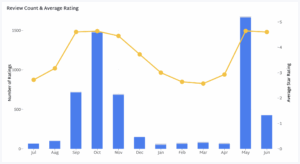
Bar Chart Shows Barbell Effect: Quantity of Reviews Improves Aggregate Review Ratings.
2. The Imperfect Perfection: Why a 4.8 Rating is More Credible Than a 5.0
While the “Barbell Effect” shows how to boost your rating, the next surprising truth is that chasing a perfect 5.0 score can be a mistake. Lanier argues that in an age of savvy consumers, a flawless rating can “smell funny,” often coming across as inauthentic or manipulated. An occasional imperfect review, paradoxically, lends credibility to your entire profile.
It signals to potential customers that they are reading feedback from real people in a real-world business, where things aren’t always perfect. As Lanier explains, this authenticity is invaluable.
“…believe it or not. I kind of wish a lot of my customers had a few more imperfect reviews because the very first thing is they lend a little bit of credibility.”
Furthermore, a negative review isn’t just a problem; it’s a public opportunity. How you respond showcases your company’s character. While a professional response is often appropriate, Lanier adds a layer of strategic nuance. When you have a high volume of positive feedback, you’ve earned the credibility to, on rare occasions, “point out that this is just a difficult customer being a difficult customer.” This shows that you’re confident in your service and won’t be held hostage by unreasonable demands, a sign of strength that savvy customers respect.
3. The Two Pillars of Trust: How Reviews Build Competence and Integrity Instantly
While a negative review can build credibility, the overall volume of positive feedback is what builds the foundational pillars of trust. According to Lanier, all business trust is fundamentally built on two pillars: competence (you are good at what you do) and integrity (you are honest and fair). Online reviews provide the most efficient shortcut to establishing both.
* Integrity: How do you prove you’re an honest business? Let your customers do it for you. When a business has a critical mass of online reviews that are free of accusations of dishonesty, it serves as powerful, unspoken evidence that you operate fairly. It’s a social proof filter that consumers instinctively use.
* Competence: A company can write 3,000 words on a white paper about its expertise, but nothing demonstrates competence more effectively than a single, sincere customer review. A real person describing how you solved their problem is a far more powerful testament to your abilities than any self-promotional claim you could ever make.
Reviews bypass traditional marketing to get straight to the heart of what customers care about, answering the two most important questions in a prospect’s mind: “Can you help me?” and “Can I trust you?”
4. Unlocking SEO Gold: Your Customers Write Better Search Content Than You Do
Beyond building trust, a consistent flow of customer reviews is one of the simplest and most effective strategies for search engine optimization (SEO). Lanier points out that reviews are a goldmine of the exact content search engines like Google are designed to find, checking all the essential boxes.
* Recent: An active review program ensures a steady stream of fresh content, which search algorithms favor.
* Relevant: The content is, by its very nature, perfectly relevant to your business and services.
* Unique: Each review is written in a customer’s own distinct voice, creating a diverse library of content a single marketer could never replicate.
The most powerful insight, however, is that the natural language your customers use often perfectly mirrors the language prospects use when they search online. Without any complex keyword research, your customers are organically creating content that lines up with what new clients are looking for. This creates an authentic and powerful SEO match that elevates your visibility without you having to write a single word.
5. More Than Marketing: The Surprising Internal Morale Boost of Customer Feedback
The final truth about reviews is perhaps the most overlooked: their impact isn’t just external. One of the most significant benefits is the powerful morale boost they provide to your internal team.
Lanier shares an anecdote about a client who was so proud of a positive review that they had a t-shirt made with the customer’s quote printed on it. For employees who work hard every day, seeing direct, positive feedback from the clients they serve is incredibly motivating. It validates their effort, connects their daily tasks to a meaningful impact, and reminds them of why their work matters.
This profound effect is something many business owners don’t anticipate. As Lanier puts it, they often “don’t know they’re hungry for ’em until they see ’em.” Once that positive feedback starts flowing in, it becomes a celebrated and vital part of the company culture, fueling a virtuous cycle of great service and great reviews.
A Final Thought
It’s time to reframe your view of online reviews. They are not a passive marketing outcome to be feared, but an active, strategic tool for building trust, improving visibility, and motivating your team. By shifting from a defensive crouch to a proactive strategy, you can unlock the immense value waiting in your customers’ untold stories.
The evidence is clear: your happiest customers are waiting to be asked. The only question left is, will you continue to let your best advocates remain silent?
Full interview is here:
Why Read or Watch the Full Interview
The full conversation goes deeper—covering compliance nuance, platform tactics, and the interplay of AI, SEO, and human trust. But even in summary, Lanier’s point is plain: reviews are no longer a side note to reputation; they are reputation. Businesses that master the discipline of asking, managing, and learning from them will own the next era of credibility.
———-
Frequently Asked Questions About Online Reviews and Reputation Strategy
1. Why are online reviews so important for my business?
Online reviews are the single most powerful form of social proof in modern marketing. They help potential clients feel confident in their decisions by showing that others have had positive experiences. Reviews reduce “buyer’s remorse,” establish trust, and influence everything from click-through rates to conversion. In most industries, they’re now as influential as personal recommendations.
⸻
2. What psychological factors make reviews so persuasive?
People want to avoid regret. Reviews satisfy that need by showing that other customers made the same choice and were happy with it. They build trust by demonstrating two key traits—competence (“you know what you’re doing”) and integrity (“you do what you say”). Even one sincere, detailed review can build more credibility than pages of marketing copy.
⸻
3. What is the “barbell effect,” and how does it hurt my reputation?
When you don’t ask for reviews, only the extremes speak up—the people who loved you and the ones who hated you. That skews ratings downward and misrepresents your real performance. Proactive review requests pull in the silent majority of satisfied clients, raising both volume and average rating while making feedback more accurate.
⸻
4. How can asking for reviews improve my average rating?
A simple, consistent invitation process transforms outcomes. One healthcare client increased monthly reviews fifteenfold and saw its average rating jump from 3.5 to 4.5 stars just by asking every customer for feedback. When they stopped, both numbers dropped immediately. The data is clear: when you ask, good experiences finally get counted.
⸻
5. Won’t asking for reviews annoy my clients?
Not if you do it professionally. The key is tone and timing. Automated, well-crafted invitations sent shortly after service show you care without feeling intrusive. MH Media Strategies helps design compliant, tactful outreach that follows the golden rule—make it as respectful as you’d want to receive.
⸻
6. What’s the best way to handle negative reviews?
Respond—don’t panic. A few imperfect reviews make your profile look authentic. A professional, empathetic reply shows accountability and strengthens credibility. Prospects pay close attention to how a business handles criticism. With the right tone, a negative review can become public proof of great customer service.
⸻
7. How do reviews affect SEO and Google visibility?
Search engines reward the same qualities good reviews deliver: recency, relevance, uniqueness, and trust. Reviews create a steady stream of keyword-rich content written in customers’ natural language—exactly what Google’s algorithm favors. They boost local search rankings and help your business appear in “near me” results and AI-powered answer boxes.
⸻
8. How does MH Media Strategies help financial advisors with reviews?
Until late 2022, SEC and FINRA rules restricted the use of testimonials. With those rules modernized, MH Media Strategies partners with Amplify Reviews to help advisors adopt compliant, first-party review programs. We handle the strategy, messaging, and workflow so advisors can collect authentic testimonials safely and confidently.
⸻
9. What is a “first-party review strategy”?
A first-party strategy means you collect reviews directly and publish them on your own website. This approach gives you compliance control, transparency, and reassurance for teams new to public feedback. It also integrates seamlessly into your SEO ecosystem, driving traffic back to your domain instead of third-party sites.
⸻
10. How can online reviews motivate my internal team?
Reviews aren’t just marketing—they’re morale. Reading real praise from clients reminds employees why their work matters. Many firms use positive reviews in team meetings or internal newsletters. One advisory firm even printed a standout client comment on T-shirts. It builds pride, purpose, and a customer-first culture.
⸻
11. How will Artificial Intelligence affect reviews?
AI will make review data easier to summarize and search, but it won’t replace human authenticity. Consumers still crave a human perspective, especially when making big decisions. AI tools can highlight themes (“clients love fast responses”), yet the emotional credibility of a genuine human voice will remain irreplaceable.
⸻
12. What industries benefit most from professional review management?
Every industry gains, but reviews are critical for sectors built on trust—financial services, healthcare, senior living, and real estate. Anywhere credibility drives conversion, a disciplined review strategy produces measurable ROI in leads, retention, and reputation.
⸻
13. How can MH Media Strategies help my company start?
We provide an end-to-end review system:
• Audit of your current reputation footprint
• Strategy for compliant, high-volume collection
• Automated workflows for email or survey integration
• Response templates and internal training
• SEO integration so reviews power organic visibility
Our process turns review management from a risk into a growth engine.

